
Author Jonathan David • Adult Student Series
Returning to College as an Adult – How to Prepare for a STEM Degree
Starting college for the first time or returning after years away? This introduction explores how to approach a STEM degree with a realistic plan, stronger study habits, and a focus on skills you can demonstrate independently.
Watch this introduction to my adult student series, or open the video on YouTube.
My Experience Returning to College
I am Author Jonathan David. My college experience included a GED, several changes in direction, community college, university study, financial challenges, and eventually a Bachelor of Science in Mathematics with a Certificate in Pure Mathematics. I also spent about 15 years tutoring students.
This series draws on those experiences to help adults entering mathematics, physics, engineering, computer science, and other calculus-based programs. Your path will have its own challenges. My goal is to share the lessons I wish I had understood earlier.
Start with Your Syllabus and Academic Policies
Before deciding how to study, read your syllabus and your institution’s code of conduct. Understand how assignments are graded, what resources are permitted, and what your instructor expects you to produce independently.
Rules about AI, tutoring, collaboration, software, and outside references vary by course. Ask your instructor when a rule is unclear. Building a study routine around the actual requirements gives you a clearer starting point.
Learn How to Use Your STEM Textbook
A textbook is more useful when you know how its definitions, examples, theorems, and exercises connect. Before searching for a worked answer, identify what the problem asks, locate the relevant material, and attempt the solution using the methods introduced in your course.
- Read the relevant definitions and assumptions.
- Study the examples and explain why each step works.
- Attempt the exercise without copying a solution.
- Check whether your answer satisfies the original question.
- Record what you could not explain and revisit that material.
The aim is to develop a method you can repeat when the next problem looks unfamiliar.
Build Software Skills While You Study
In the video, I emphasize practicing Microsoft Word and other Microsoft Office tools throughout your education. When your instructor permits it, coursework can provide regular practice in organizing documents, typing equations, working with data, and communicating technical ideas clearly.
Review current job listings for the roles you hope to pursue. Use their stated requirements to identify relevant tools, which may include Microsoft Office, CAD software, programming environments, or statistical software. Requirements differ across employers and disciplines; build skills that match your intended work.
Practice in the Format of Your Exams
Preparing a polished assignment and solving a problem under exam conditions are different tasks. If your exams are handwritten, include handwritten practice. If they restrict software or references, rehearse with those same restrictions.
Measure Your Progress by What You Can Explain
Returning students may feel discouraged when classmates seem quicker or more confident. You rarely know another student’s preparation or previous experience with the material. Focus on your own progress: Can you explain a definition, justify a step, and solve a related problem without someone supplying the method?
Be comfortable saying, “I do not know yet.” Recognizing a gap gives you something concrete to work on. The goal is to leave college with knowledge you can use and communicate.
How My Ultimate Crash Course Fits into Your Studies
The Ultimate Crash Course for STEM Majors brings together study guidance, formulas, equations, worked solutions, and lessons from my years of studying and tutoring. It covers topics including calculus, physics, linear algebra, and differential equations.
I describe the series as a reference for reviewing foundational material and comparing how solutions are written, especially as you approach junior-level work. Use it alongside your assigned textbook and within your course’s resource policies. The advanced solution material also illustrates how to move from a question to a justified answer and check that the answer meets the original requirements.
Prepare for Your Next Chapter in College
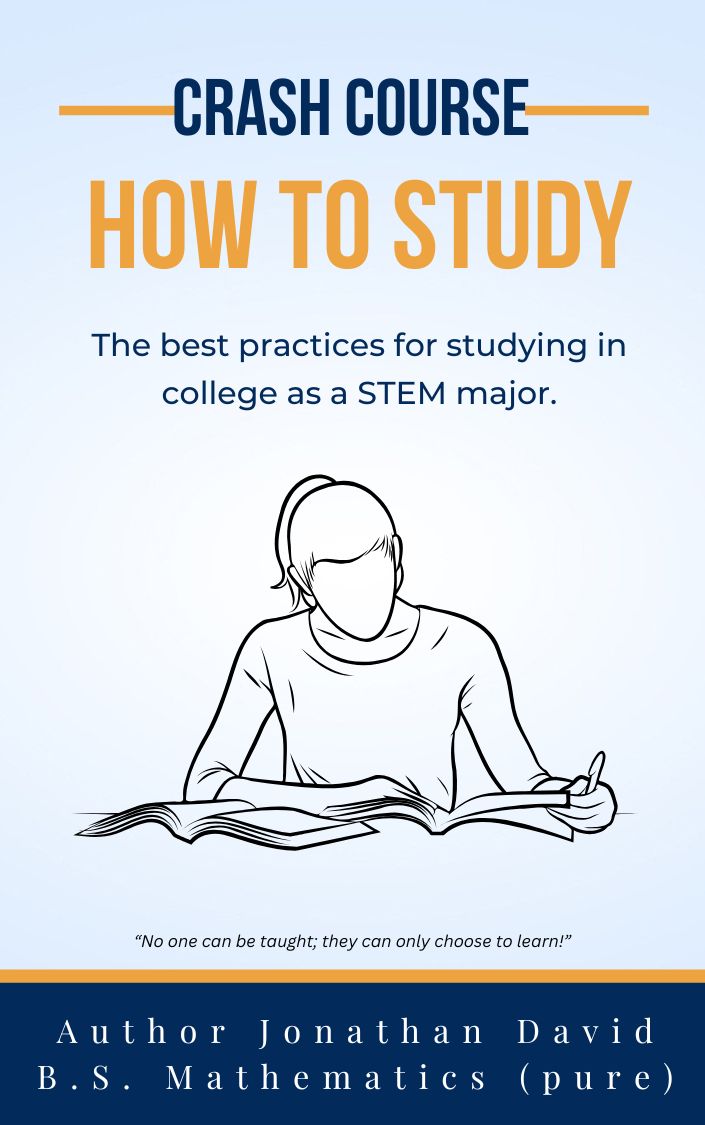
Explore my How to Study guides and Ultimate Crash Course books, or visit my website for membership options and available reading, podcasts, and audiobooks.
Explore My Book Store View Membership OptionsAdapted from the video podcast by Author Jonathan David. Personal experiences and study recommendations are shared for general guidance; follow your institution’s policies and your instructor’s assignment requirements.