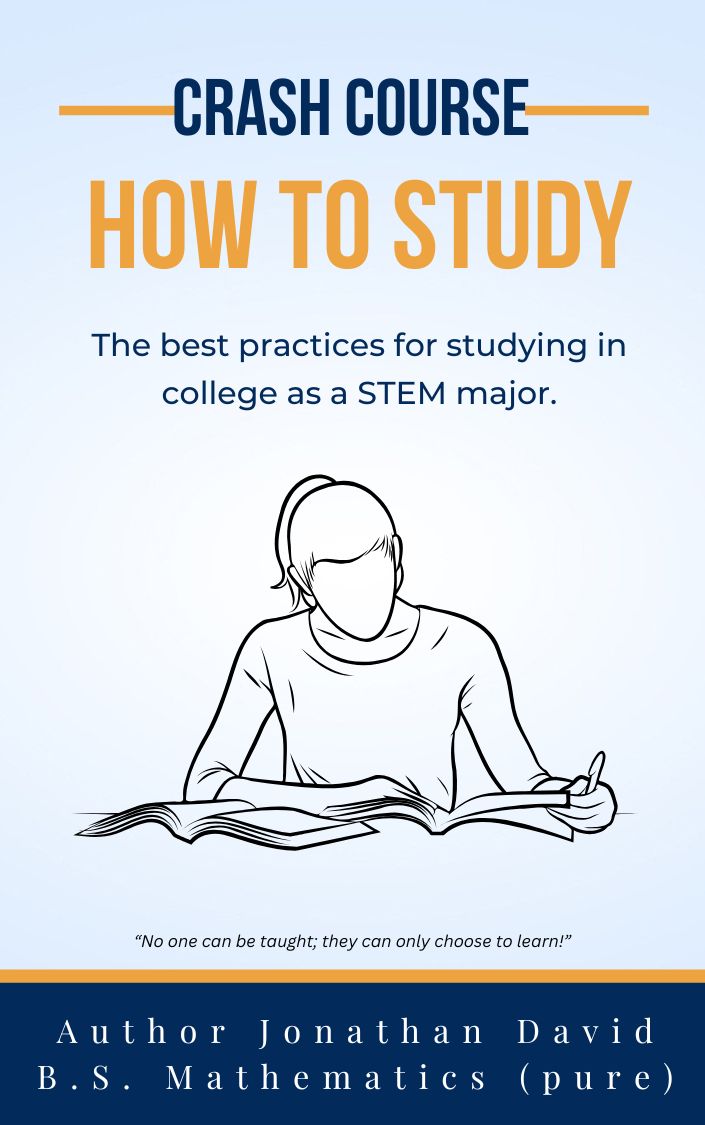

The Red Edition Crash Course vs. the Quartic Play — What’s the Difference?
The main difference is the additional material: the Quartic Play includes The Daily Dose, while the Red Edition includes approximately 200 additional textbook-size pages of advanced mathematical and physics solutions.
In this video, Author Jonathan David opens the documents, compares the writing styles, and explains how the additional Red Edition material focuses on presenting solutions, identifying errors, and checking mathematical work.
The Two Editions at a Glance
| Edition | Distinguishing Material |
|---|---|
| Quartic Play | Includes The Daily Dose, with short daily readings for college STEM majors. |
| Red Edition — The Ultimate Crash Course for STEM Majors | Includes approximately 200 additional pages of advanced solutions emphasizing professional presentation, error correction, and the “full circle of math.” |
What Is The Daily Dose?
The Daily Dose provides brief entries intended for regular reading. Jonathan explains that some readers appreciate this daily-reading component, while others prefer the additional technical material in the Red Edition.
If that daily reading is important to you, it is the key feature to look for in the Quartic Play.
What Do the Additional Red Edition Pages Cover?
The additional collection contains more advanced work aimed primarily at junior- and senior-level STEM study, with some graduate-level material. Examples discussed or shown in the video include:
- Laplace transforms and unit impulse functions.
- Differential equations.
- Linear algebra.
- Mathematical proofs.
- Maxwell’s equations and other physics material.
The approximately 200 pages refer to the size of the additional collection, rather than a confirmed count of 200 individual problems.
Student-Style Notes and Professional Solution Writing
Jonathan compares two approaches within his work. The earlier crash course often presents calculations in a flowing, student-note style. The newer material places more emphasis on organizing the solution, explaining the reasoning, and delivering the information clearly.
- Earlier material: A reference for reviewing methods and following the progression toward an answer.
- Additional material: A closer examination of how to present, check, correct, and finalize mathematical work.
The comparison gives readers examples they can use to assess the clarity and completeness of their own solutions.
Why Some Mistakes Remain Visible
In one demonstrated Laplace-transform problem, Jonathan explains how using the same letter for parameters from different formulas led to an error. A small notation mismatch affected the subsequent calculations and took considerable time to locate.
Rather than hiding the mistake, he preserves the relevant work and marks where the error occurred and how it was corrected. The purpose is to show the checking process alongside the finished solution.
- Keep the meaning of each symbol clear.
- Distinguish parameters that represent different quantities.
- Check substitutions and exponents carefully.
- Trace an incorrect result back through the working.
- Show corrections clearly enough that another reader can follow them.
The “Full Circle of Math”
Jonathan uses this phrase to describe the broader process of working through a problem, checking the reasoning, finding and correcting mistakes, and presenting a finished solution.
The additional pages document that process through detailed examples. Patience and careful notation are part of the work, particularly when a small error produces a much larger discrepancy.
Hardcover and Handmade Editions
The video primarily compares the hardcover books. Jonathan also discusses handmade versions, which he describes as distinctive collector’s items.
He notes that compressing the material into a smaller handmade format can reduce the text size and require turning the book to read some pages. Readers choosing a study reference should consider readability alongside the appeal of the physical edition.
PDF Access and Video Library Offers
At the time of recording, Jonathan explains that hardcover purchases include the PDF package, delivered by email after purchase. He also discusses a limited fall-semester 2026 offer providing lifetime access to an accompanying video library with qualifying packages.
The library includes recordings connected with his earlier crash course work. He explains that recordings of all the newer additional material are not currently available.
Check the current product listing for the exact package contents, delivery details, access instructions, and any active bonus offer. The prices and future pricing discussed in the video describe the offer at the time it was recorded.
Which Edition Should You Choose?
- Choose the Quartic Play if The Daily Dose readings are the distinguishing feature you want.
- Choose the Red Edition if your priority is the additional advanced solutions and examples of professional mathematical presentation.
- Consider the PDF package if you prefer digital access. Review the listing to confirm which books and editions it contains.
Explore the Books and Full Library
Visit the store to compare available editions and bundles. For podcasts, ebooks, educational material, fiction, and author-narrated video audiobooks, visit Author Jonathan David’s website.
Every other video is free, and the alternating videos are for members. Become a member for full access to my lessons, podcasts, reading library, and video audiobooks—all ad-free on my website.
Monthly and annual members can request podcast topics. Requests are addressed one at a time in the order received, with up to two requests per month. Members can also comment and interact with other members.
Disclaimer: My videos and podcasts express personal opinions and are intended strictly for entertainment. Commentary may include speculation, hearsay, satire, or fictional material and should not be treated as verified fact or professional advice. This post summarizes the editions and offers described in the video; consult current product listings before purchasing. Educational resources should be used within your institution’s academic-integrity policies. Fictional works may contain mature themes and are recommended for audiences 18 and older.