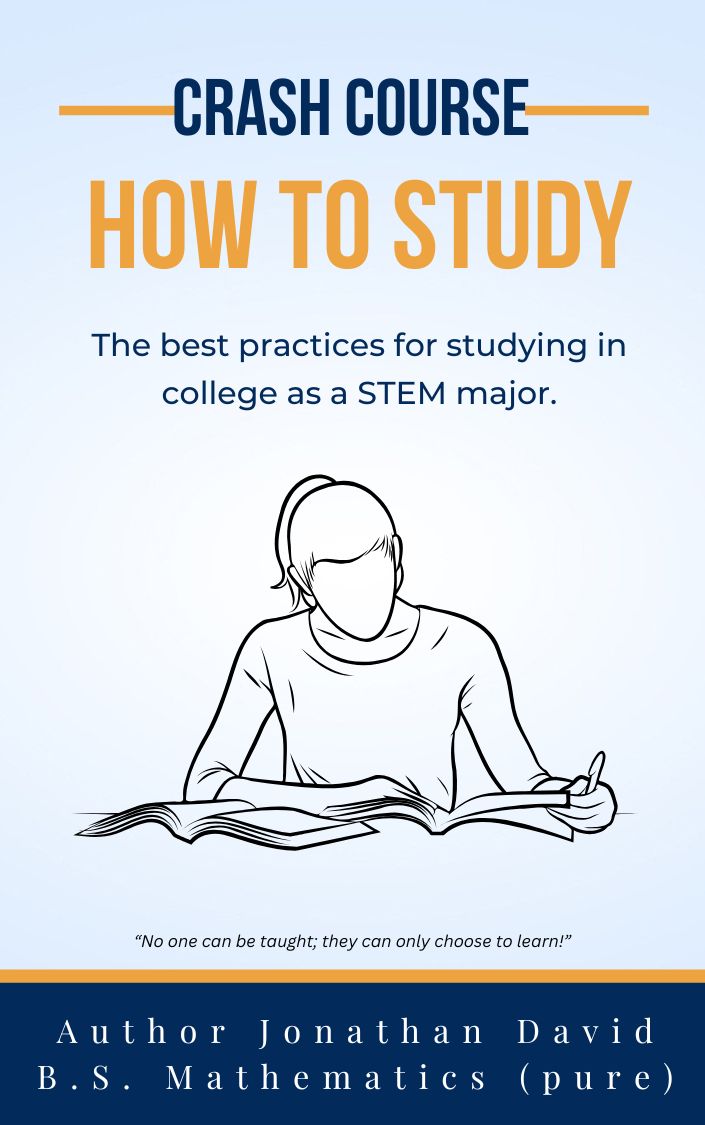

Sample preview: The original book page is an image. This written expansion explains part of that page to provide a readable sample of the lesson; it is not the complete book or lesson.
The Ultimate Crash Course for STEM Majors · Sample Lesson
Before Starting Math: Understanding the Question Comes First
By Author Jonathan David
Before studying prealgebra, college algebra, or calculus, develop a habit that supports every course: understand what the question asks before calculating. Learning mathematics involves reading definitions, interpreting symbols, choosing appropriate tools, and explaining why your answer follows.
This sample introduces “The Full Circle of Math”: move from the question to a solution, state your answer, and then justify or check it.
Read Mathematics as a Language
Mathematical notation communicates relationships. Words such as solve, simplify, evaluate, and prove give different instructions. Recognizing those instructions helps you determine what a complete response requires.
- Solve: Find the values that satisfy an equation or condition.
- Simplify: Rewrite an expression in an equivalent, more useful form.
- Evaluate: Determine a value using the information provided.
- Prove: Establish a claim through a valid logical argument.
For example, $2x+3$ is an expression, while $2x+3=11$ is an equation. Without additional information, the expression does not determine a particular value of $x$. The equation gives a condition you can solve.
Learn Your Textbook’s Definitions and Conventions
The original page encourages students to notice the textbook they are using, including its author and title. The practical lesson is to work carefully with your assigned book’s definitions, notation, examples, and prerequisites.
Algebra textbooks share mathematical principles, but authors may organize topics differently or use different conventions. Read the relevant section before borrowing a method from another source, and make sure you understand why that method applies.
When a course requires references, identify the definition, theorem, or textbook page supporting your reasoning. A reference supports your explanation; it does not replace it.
The Full Circle of Math
Question → Solution → Answer → Justification or Check
- Understand the question. Identify the instructions, the given information, the unknown quantity, and any restrictions.
- Write the solution. Select the definitions or rules you need, then apply them in a logical sequence.
- State the answer. Make your conclusion easy to find. Include units, conditions, or context when needed.
- Justify or check the result. Explain why your reasoning is valid and test the answer against the original conditions where appropriate.
A written solution can be organized like a short essay: the question gives the purpose, the introduction identifies the tools, the body develops the reasoning, and the conclusion states the result.
Example: Solve and Check a Linear Equation
This added example illustrates the method described on the original page.
Question: Solve $2x+3=11$.
Tools: Use the properties of equality. Subtracting the same quantity from both sides preserves equality, as does dividing both sides by the same nonzero number.
Answer: The solution is $x=4$.
Check: Substitute the result into the original equation:
The substitution confirms that $4$ satisfies the equation. The reversible steps above also establish that it is the only solution. In more advanced problems, checking a candidate answer alone may not prove uniqueness or establish a general claim.
Practice the Reasoning Before Using Technology
The original lesson recommends practicing this process without technology first. For a foundational exercise, try to explain each step yourself before consulting a calculator or an automated solution.
The goal is to understand the method well enough to recognize an invalid step, explain your answer, and check whether it satisfies the question. The amount of justification should fit the task: a routine calculation and a formal proof require different levels of detail.