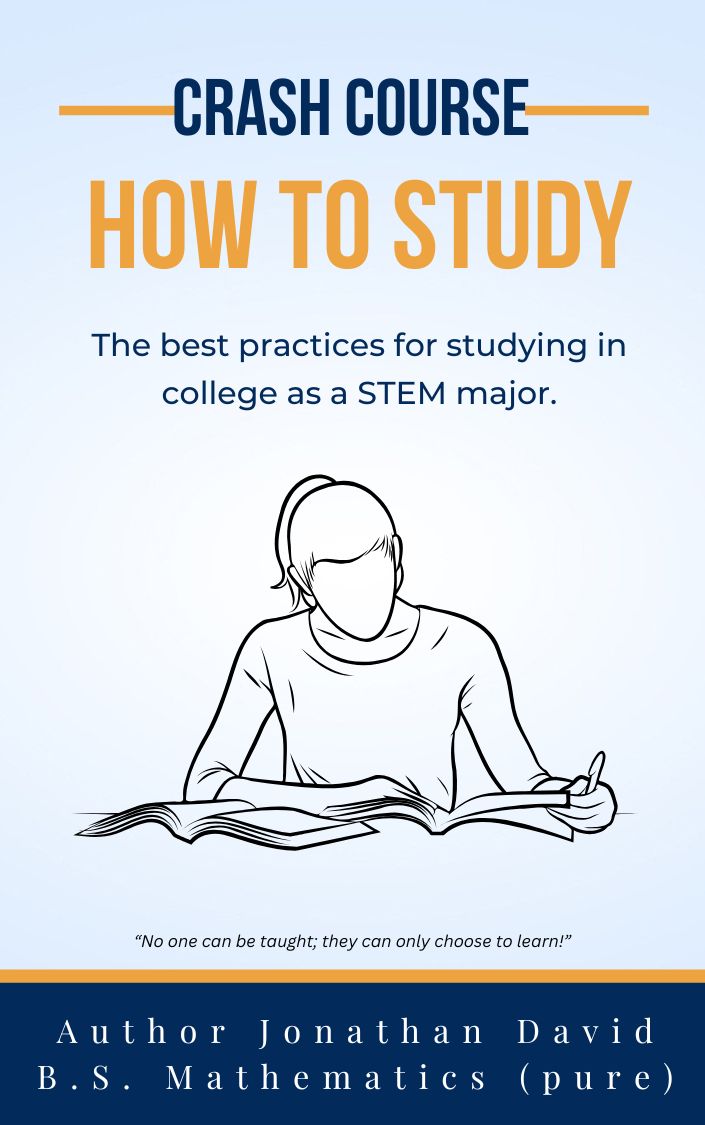

Adults Returning to College — Preparing for a STEM Degree
Starting college as an adult—or returning after time away—comes with questions about studying, working, choosing a degree, and preparing for employment. In this introductory podcast, Author Jonathan David shares lessons from his own college experience and approximately 15 years of working with students.
About This Podcast Series
This series is dedicated to adults attending college for the first time or returning to complete their education. Its primary focus is preparing for calculus-based degrees in mathematics, physics, engineering, computer science, and related fields.
Jonathan describes a path that included earning a GED, exploring different subjects, working in sales, attending community college, transferring to a university, and completing a mathematics degree. He shares those experiences to help students think through their own decisions.
1. Begin with the Syllabus and Code of Conduct
- Read your institution’s code of conduct. Understand the academic-integrity rules and expectations that apply to you.
- Read the syllabus for every course. Identify required materials, assessment formats, attendance expectations, deadlines, and permitted resources.
- Check before using outside assistance. Rules for AI, tutoring, videos, collaboration, and software vary by course. Ask your instructor when the policy is unclear.
- Practice following instructions consistently. Jonathan connects this habit with mathematical reasoning and the ability to follow workplace procedures.
2. Learn to Work with Your Assigned Textbook
A central message of the podcast is to develop the ability to read and use your course materials independently. Rather than immediately looking for someone else’s explanation, spend time understanding the definitions, examples, notation, and instructions in the assigned text.
- Become familiar with how your textbook organizes topics and examples.
- Pay attention to the meaning of mathematical terms and symbols.
- Work toward explaining why a solution works, rather than only reproducing its steps.
- Use questions to identify a specific difficulty you can discuss with your instructor.
3. Build Software Skills Alongside Your Coursework
Jonathan recommends using coursework to practice producing clear digital documents and working with professional software. His preferred workflow uses Microsoft Word and other Microsoft Office tools to write mathematics, organize information, and communicate solutions.
- Practice writing clear mathematical solutions. When your instructor permits digital submissions, use the opportunity to improve your document formatting and equation-writing skills.
- Develop familiarity with a range of tools. Depending on your field, relevant software may include spreadsheets, presentation tools, CAD, statistical software, or other specialized applications.
- Review job postings for roles that interest you. Note the software and communication skills employers request, then use that information to guide your practice.
- Follow the course’s submission requirements. Use the format and tools your instructor requires.
4. Practice in the Format of Your Exams
Digital coursework and exam preparation can serve different purposes. Jonathan recommends regular practice exams and matching your practice conditions to the assessment you will actually take.
- If an exam is handwritten, practice solving problems by hand.
- If it is timed, include timed practice in your preparation.
- Use only the resources that will be permitted during the exam.
- Check whether you can complete and explain the work independently.
5. Avoid Comparing Your Progress with Classmates
Returning students may find themselves studying alongside people who have recently completed high school or taken related courses. Someone who answers quickly may have prior experience with the material. Their performance does not tell you what your own learning pace should be.
- Focus on your preparation and progress.
- Allow time to rebuild skills you have not used recently.
- Balance your course load with work and other responsibilities.
- Recognize that needing more practice is part of learning.
6. Be Honest About What You Know
Jonathan encourages students to become comfortable saying, “I don’t know the answer to that.” Education involves recognizing the limits of your knowledge and learning how to resolve them.
- Distinguish a supported answer from a guess.
- Use definitions precisely when explaining your reasoning.
- Ask for clarification when you do not understand a question.
- Practice clear written and spoken communication.
7. Aim for Understanding That Lasts Beyond the Course
The podcast emphasizes the difference between completing an assignment and developing the ability to do the work independently. Jonathan warns against relying on outside answers without understanding the reasoning behind them.
Use permitted learning resources in ways that strengthen your own ability. A useful check is whether you can solve a similar problem, explain your method, and recognize mistakes without someone supplying the answer.
How the Ultimate Crash Course Fits In
The Ultimate Crash Course for STEM Majors is presented as a reference and study companion for calculus-based education, particularly as students approach upper-level coursework.
Jonathan describes the collection as a way to review material, compare solution-writing approaches, and identify gaps in preparation. It includes study guidance, formulas, equations, worked solutions, and observations developed through his studies and work with students.
- Review foundational mathematics and physics used in later courses.
- Compare the organization and clarity of your solutions with examples.
- Explore material connected with calculus, linear algebra, differential equations, and physics.
- Use the collection alongside your assigned materials and within your course’s resource policies.
Your Starting Checklist
- Read the code of conduct and each course syllabus.
- Confirm which resources and software are permitted.
- Learn how to navigate and study your assigned textbook.
- Plan a manageable workload around your responsibilities.
- Practice writing clear solutions and using relevant software.
- Schedule regular practice in the format of your exams.
- Review job requirements to understand the skills you want to develop.
Explore the Books and Full Library
Visit Author Jonathan David’s website for study guidance, educational content, podcasts, ebooks, and video audiobooks. Explore the store for the Ultimate Crash Course and other available books and bundles.
Every other video is free, and the alternating videos are for members. Become a member for full access to my lessons, podcasts, reading library, and video audiobooks—all ad-free.
Monthly and annual members can request podcast topics, with requests addressed one at a time in the order received. Members may submit up to two requests per month.
Disclaimer: My videos and podcasts express personal opinions and are intended strictly for entertainment. Commentary may include speculation, hearsay, satire, or fictional material and should not be treated as verified fact or professional advice. Academic policies and employment requirements vary; consult your institution, instructors, and relevant employers for their requirements. Fictional works may contain mature themes and are recommended for audiences 18 and older.